
Comfort in learning is a paradox. You can’t become truly comfortable with a skill until you’ve practiced it enough to master it. But practicing it before you master it is uncomfortable, so you often avoid it.
Hidden Potential, Adam Grant
My students enjoy coming to their pull-out gifted enrichment class (at least that’s what they tell me!). Many reasons for this come to mind, but I hope that one of them is not that the work is “easy.”
The “New Expert” Project
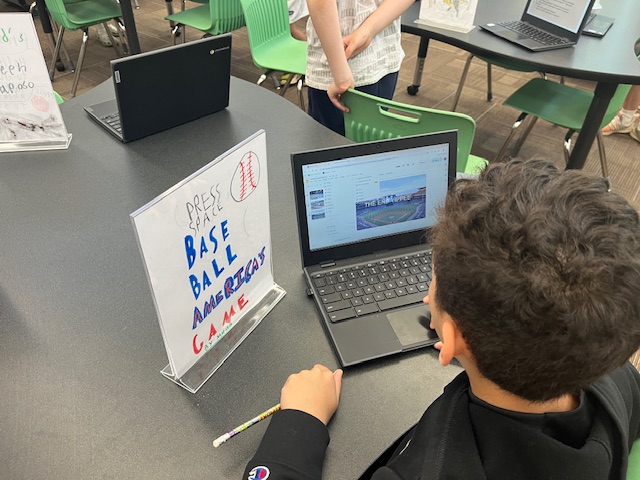
We just completed a “New Expert” research project where they chose a topic they knew nothing about and developed presentations. The students moaned a bit over the number of facts and authoritative resources I required–which I took as a good sign: it shouldn’t be within their comfort zone.
I allowed them to use any presentation tool of their choice, and some of those I was not familiar with such as Wixeditor–which meant I was not the expert. Did they do their own problem-solving? Yes. Did they enjoy it? Overall, yes. Eventually.
Three Project Elements That Helped
They had moments of frustration, but the “New Expert” project worked well for three reasons:
- Choice – A focus on format for their presentations allowed them to express their facts as they chose, ranging from Google Slides to Stop Motion.
- Challenge – If you know more, you learn less. Requiring a new topic invited students to move outside of their comfort zones, while still allowing for choice of topic.
- Consider the Crowd – When students heard they were presenting to the other REACH group, everything changed. Their concentration and ideas were elevated because they knew others (besides the teacher) would see their work.
“Multimodal and multi-sensory approaches include accessing or producing information in various written, visual, performance-based, or oral forms.” (Nicholas et al. 2024)
Conclusion
Teachers matter, particularly when students lack confidence in their ability or want to remain in their comfort zones. When we provide them support to move beyond their known abilities, we can give them an opportunity to not only build skills and knowledge but also a desire to learn.
Learner identity is not a fixed thing; rather, it is contradictory in nature and constantly impacted by curricular and pedagogic regimes. … I argue that pedagogic practices, which appear to generate affects and open up spaces for embodying a desire to learn, need to be brought to the fore in classrooms.
SOURCES
Grant, A. (2023). Hidden potential: the science of achieving greater things. Random House.
Nicholas, M., Skourdoumbis, A., & Bradbury, O. (2024). Meeting the Needs and Potentials of High-Ability, High-Performing, and Gifted Students via Differentiation. Gifted Child Quarterly, 68(2), 154-172. https://doi-org.ezproxy.neu.edu/10.1177/00169862231222225
Xu, W. (2024). Dominic’s Story: The “Pedagogy of Discomfort” and Learner Identity in Flux. Journal of Language, Identity & Education, 23(2), 243–255. https://doi.org/10.1080/15348458.2021.1988604
 Gifted Weekly