
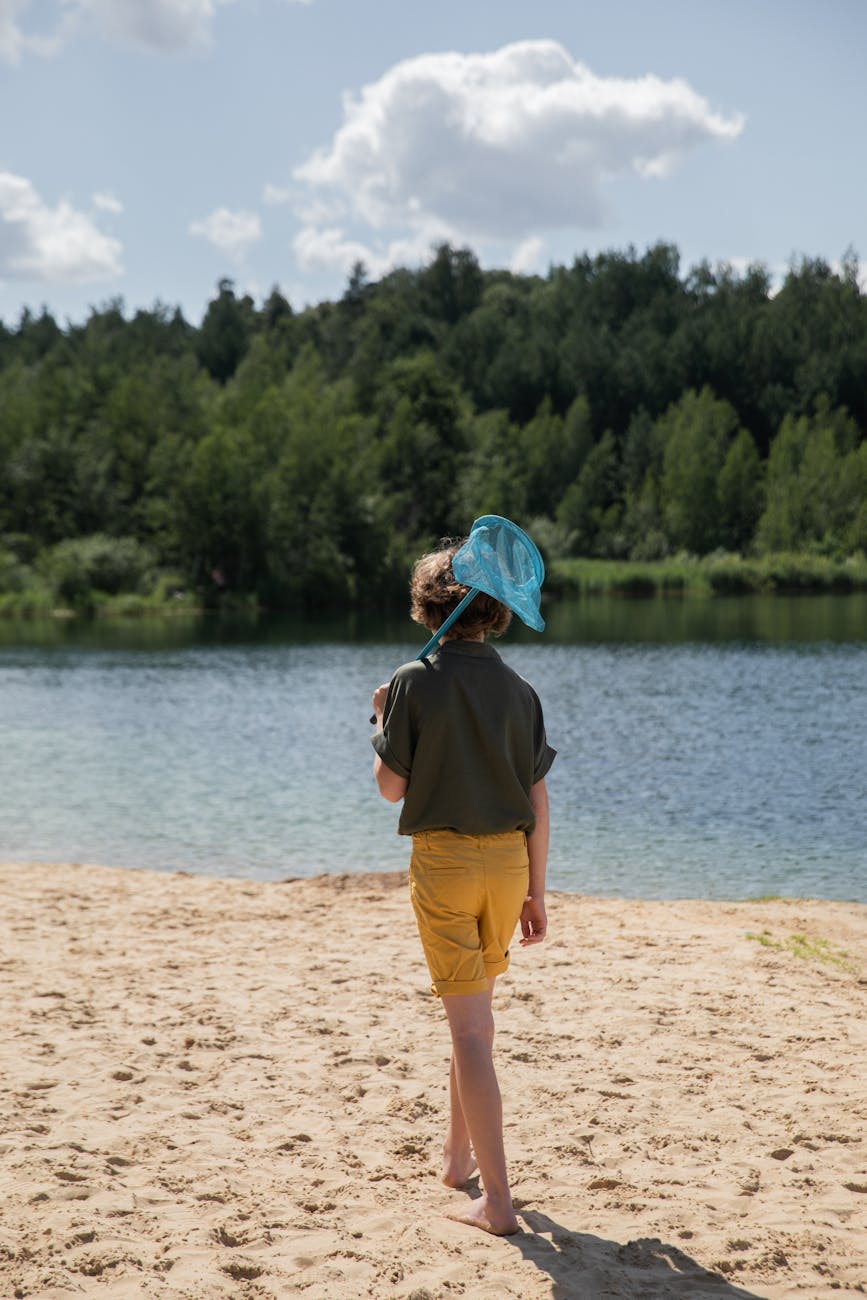
There is plenty of research supporting the benefits of unstructured time (see books by David Elkind, Richard Louv), daydreaming (McMillan et al., 2013; Singer, 1955), and overall languor. However, providing high-ability student brains with a legitimate area of interest to explore over the summer months does not detract from those other benefits. In fact, if we work with our students to build on their interests, a few structured summer activities can help them grow rather than founder.
Choose, Create, and Connect: Encouraging Summer Growth
As a child of the 1970s, I have memories of summer days spent leaving the house in the morning and returning at dinner time. There were many lessons inherent to that wandering (discovering crayfish in the creek, maneuvering friendships during kickball, and so on). But many childhoods no longer run that way, and even those that do can benefit from encouragement to Choose, Create, and Connect.
Choose
Allowing students to choose an area of interest within a supportive environment can provide them with friendships outside their normal social circles, increased confidence and pride in their abilities, and a sense of accomplishment. They can go from “liking to draw” to considering themselves an artist! The ability to change one’s self-concept grows from this original ability to act on a perceived interest, which extends into career choices later on (Maree, 2022).
“If the “storyline” that runs through their career- and self-identities is clear, if they know who they are, where they are headed, why they are living and working, what life means to them, and what the sense of purpose in their career-lives is, their chances of dealing successfully with change and its impact are bolstered.”
Jessica Maree, 2022
Areas of interest to consider for camps and lessons:
Coding, Sewing, Drama, Art, Sports, Engineering, Music, Dance, Environmental Stewardship
Local volunteer opportunities:
Animal shelters, Food Banks, Trail Cleanup, Book donations, Lemonade stand for charity, Lists of local volunteer options for kids (New Jersey example)

Create
Extending from the idea of Choice is the goal to Create. Setting up the parameters for students to choose an area of interest and engage in learning that leads to a concrete product can increase the sense of accomplishment – and set them up for key stories to relate to in future interviews! Is a student interested in graphic novels? Maybe you sit down with them to craft their own graphic story over one rainy week in July. Place the finished product in a plastic sleeve for the keepsake box or reach out to Jerry Craft, Nathan Hale, Jarrett J. Krosoczka, or Liz Montague for feedback.
Resources to support student creation:
Visit your local library! Your librarian would love to help you find books, camps, and other resources to make this seed become a full-blown flower.

Connect
Some of our high-ability students, like any other human being, can be introverted and less likely to reach out to others. To build on the concept of Choice, providing students with at least one experience over the summer that taps into their interest, in the company of like-minded students, can provide opportunities for social development outside of the school environment. This can take the extreme form of an overnight camp, a day camp, or 1-2 hour in-person group lessons.
This study also corroborates the findings of (Olszewski-Kubilius & Limburg-Weber 1999), who said enrichment programs can function as networks of social support for students with gifts and talents, and this support can also be achieved across ethnic and national boundaries, as evidenced by the students’ beliefs that friendship is one of the most important intercultural lessons they received from the program.
Corrine Green, 2020, p. 179.
Camp options:
- John Hopkins University Summer programs grades 2 – 12
- Davidson Institute for Talented Youth Three week residential camp ages 13 – 16
- NJAGC Summer Scholarship tips
- The Exploration Junior Program St. Mark’s School in Massachusetts, grades 4 -12
- Also: Municipal, school, YMCA, religious, and local for-profit camps
Gifted students often face unique challenges within traditional educational settings. They may feel bored or unchallenged by the standard curriculum, leading to disengagement or underachievement. Summer breaks, while a time of relaxation for many students, can exacerbate these issues for the gifted. Enrichment programs provide a solution. Supporting our students so that they can Choose, Create, and Connect gives them helpful direction in the midst of the greater sense of freedom they have over the summer.
SOURCES
Green, Corinne R (2020). Examining the Intercultural Understandings of Adolescents With Gifts and Talents Attending a Multicultural Summer Enrichment Program. Purdue University Graduate School. Thesis. https://doi.org/10.25394/PGS.12739421.v1
Maree, J.G. Using Integrative Career Construction Counselling to Promote Autobiographicity and Transform Tension into Intention and Action. Educ. Sci. 2022, 12, 72. https://doi.org/10.3390/educsci12020072
McMillan et al. Ode to positive constructive daydreaming. Frontiers in Psychology. Volume 4 – 2013. https://doi.org/10.3389/fpsyg.2013.00626
Singer, J. L. (1955). Delayed gratification and ego development: implications for clinical and experimental research. J. Consult. Psychol. 19, 259–266. https://doi.org/10.1037/h0044541
NOTE: A version of this article, written by me, might also appear in the NJAGC Promise Newsletter, June 2024.

