
Category: gifted education
-
The Importance of Language: MLs or ELLs with High Academic Potential

The gifted gap is well-documented, but those who fall through vary from region to region. At a local research site, English Language Learners (ELLs) were found to have the lowest representation in the gifted program (Wise, 2023). One English as a Second Language (ESL) teacher explained, “I didn’t know that…
-
Be Specific: Planning for G/T Outcomes

In the latest Texas Association for Gifted & Talented (TAGT) podcast featuring Celeste Sodergren, Director of Advanced Academics in the Waco, Texas, Independent School Distirct (WISD), she explores the need to map specific projects to skill development, with each skill rolling up to a larger skill set.
-
What is enrichment?

Although enrichment has taken up increasing space in student schedules, the goals of such programs are unclear.
-
Motivation Matters for Gifted Growth

How many times have we second-guessed how to motivate and challenge the gifted child? Too much praise is problematic (Glass & Tabatsky, 2014), but we also want to recognize student effort and achievement. For gifted students, the student’s status and self-identification as a “gifted child” and how that impacts their…
-
Gifted DEI Efforts: What Does the Admin Think?

“Equity” muttered with an eye roll is an unfortunate side effect of Diversity and Equity Inclusiveness (DEI) efforts over the past few years. I have heard frustration expressed by those across the political spectrum with DEI’s performative aspect, its ineffectiveness, and the polarizing nature of large-group equity conversations. During doctoral…
-
Back to School with Gifted Weekly

Many schools have already started back to school (shout out to my niece and nephew in Georgia!) but others wait until after Labor Day, such as in New Jersey. Whether back in session or still wrapping up summer vacations and projects, teachers are undoubtedly gearing up to engage their students…
-
Differentiation Part Two: How Gifted Learners Grow

“Really, to me, differentiation is the common sense of saying, if we take on the responsibility of teaching, we accept the responsibility of making sure that every kid learns as well as he or she possibly can.” – Carol Tomlinson (Bell, 2011) As we seek to address the needs of…
-
iReady as an Indicator of Giftedness?

Districts have long searched for an online tool to support all assessments. Serving as a diagnostic Swiss knife, the online program should measure mastery of skills, remediate as necessary, challenge where appropriate, and provide fine-tuned data to allow a grade-level team to address learning gaps. For many districts, these tools…
-
Addressing the Decline in High Achievers’ NAEP Math and Reading
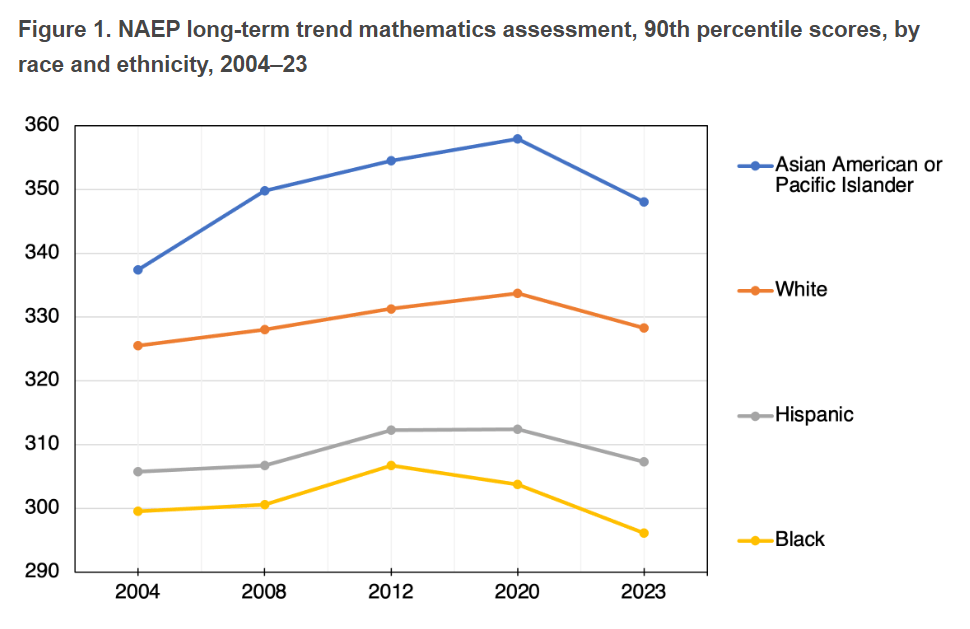
The decline in math skills and reading comprehension is not news, but the specific data reported by the National Center for Education Statistics (NCES) this year should intensify our overall sense of alarm. “The average scores for 13-year-olds declined 4 points in reading and 9 points in mathematics compared to…
-
Opportunity and Access: Math Acceleration

Recently published research in the July 2023 issue of Gifted Child Quarterly links unequal access, once again, to under-resourced communities. When considering access to accelerated math instruction (Peters & Carter, 2023), namely Algebra in grade 7 and Geometry in grade 8, districts that offer more challenging math courses are not…
 Gifted Weekly