
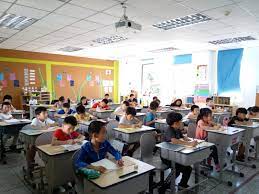
First of all, wow. In this New Yorker article, journalist Peter Hessler shared his family’s experience with enrolling their daughters in an elementary school in Chengdu, China, and I could not have been more surprised by the expectations placed on those children in light of my own public school experience. Although I have had friends and students explain the differences between the two countries’ educational systems to me, the details shared by Hessler were beyond what I had imagined. Those with whom I have discussed the article agree: the rigor of the 3rd grade in Chengdu is grades beyond what we see in the U.S.
Headlines in the U.S. beat the drum of concern over the dismal state of affairs:
- “America’s Education System Is a Mess, and It’s Students Who Are Paying the Price” (The 74)
- “Our Failing Schools Are a National Crisis” (City Journal)
- “It’s Not Just Math and Reading: U.S. History Scores for 8th Graders Plunge” (The New York Times)
… while China secured the top spot in the most recent PISA assessments of math, science and reading. The US stands at number 22 in overall PISA rankings (OECD Country Report 2018; World Population Review). (Note: Tested regions in China are the more affluent areas of Beijing, Shanghai and neighboring provinces.)
What stood out the most in the Double Education article? The contrasts in time in school, the locus of control, and rigor of content.
Time in school: First of all, Hessler shares that his daughters attended school throughout the year with infrequent breaks, resulting in 30% more school days than in their Colorado public school. In addition, the substantial majority of parents paid for supplemental instruction, one of whom shared with the journalist:
Once, when my family had dinner at the home of one of the twins’ classmates, her parents said they hated enrolling their child in private supplemental courses. “Would I rather have her relaxing and learning things other than math?” the father said. “Of course. But there’s nothing I can do about it. That’s the way all parents feel. It’s too competitive. But, if you want your child to have a chance, you have to do all this stuff.”
Locus of control: The school, through the role of the teacher, set the agenda, and the parents fell in step. “The system also maximized parental support while minimizing input to effectively zero… There were no suggestions, no complaints, and no criticisms. The message from the school was clear: We are in charge.”
Rigor of content: While that word is overused, the expectations for 3rd grade math are encapsulated by the adjective “rigourous” nonetheless. One example sends my own adult mind spinning: “A certain number, when divided by 3, leaves a remainder of 2; when divided by 4, leaves a remainder of 3; when divided by 5, leaves a remainder of 4. What is the smallest that this number could be?” As a homework problem for nine year olds, it is formidable. The priority given to math impacted the entire school day. When the journalist asked his daughters about homework, the answer was math; when he asked them about recess, the answer was, again, math.
The benefits of this approach are obvious – mastery of math material for over 40% of students (China) vs. less than ten percent of students (the U.S.). The author observes, however, that curiosity and independence are framed negatively, the impact of which shall be explored in future posts.
It is worth considering how, in China, this is a 3rd grade math problem shared by Hessler:
While multiplying one two-digit number by another two-digit number, Little Sloppy misreads 22 as 25, and as a result his answer is higher than the correct answer by 69. What is the correct answer?
And in the U.S., we find this on iXL for the same addition/subtraction word problem category:
Over the weekend, Aubrey sold boxes of cookies in her neighborhood. She sold 9 boxes of cookies on Saturday. She sold 3 times as many boxes of cookies on Sunday as she sold on Saturday. How many boxes of cookies did Aubrey sell on Sunday?
I know which one I will get right.
 Gifted Weekly
