“I think every kid [should have] an opportunity to participate in a program like this or lesson like this, so that they can enhance their opportunity to have higher-level thinking. It allowed students, who otherwise would struggle, to highlight their artistic and creative abilities. I was surprised to see how creative some students were, that have not had a chance to show their creativity.”
Rachel, 4th grade teacher
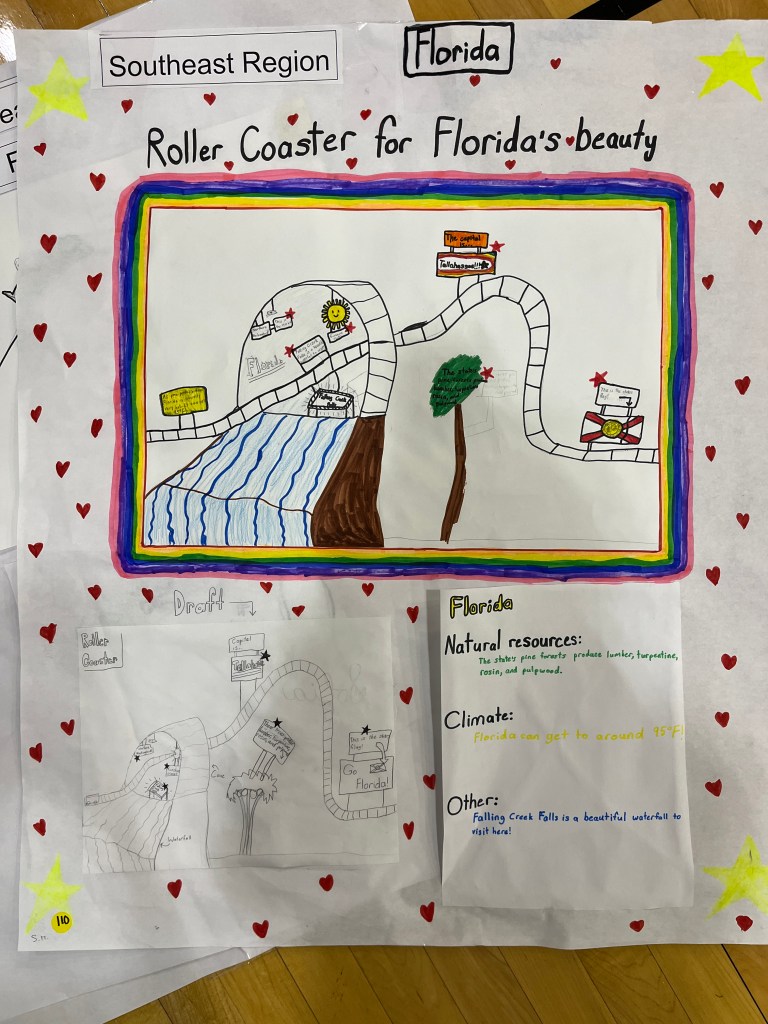
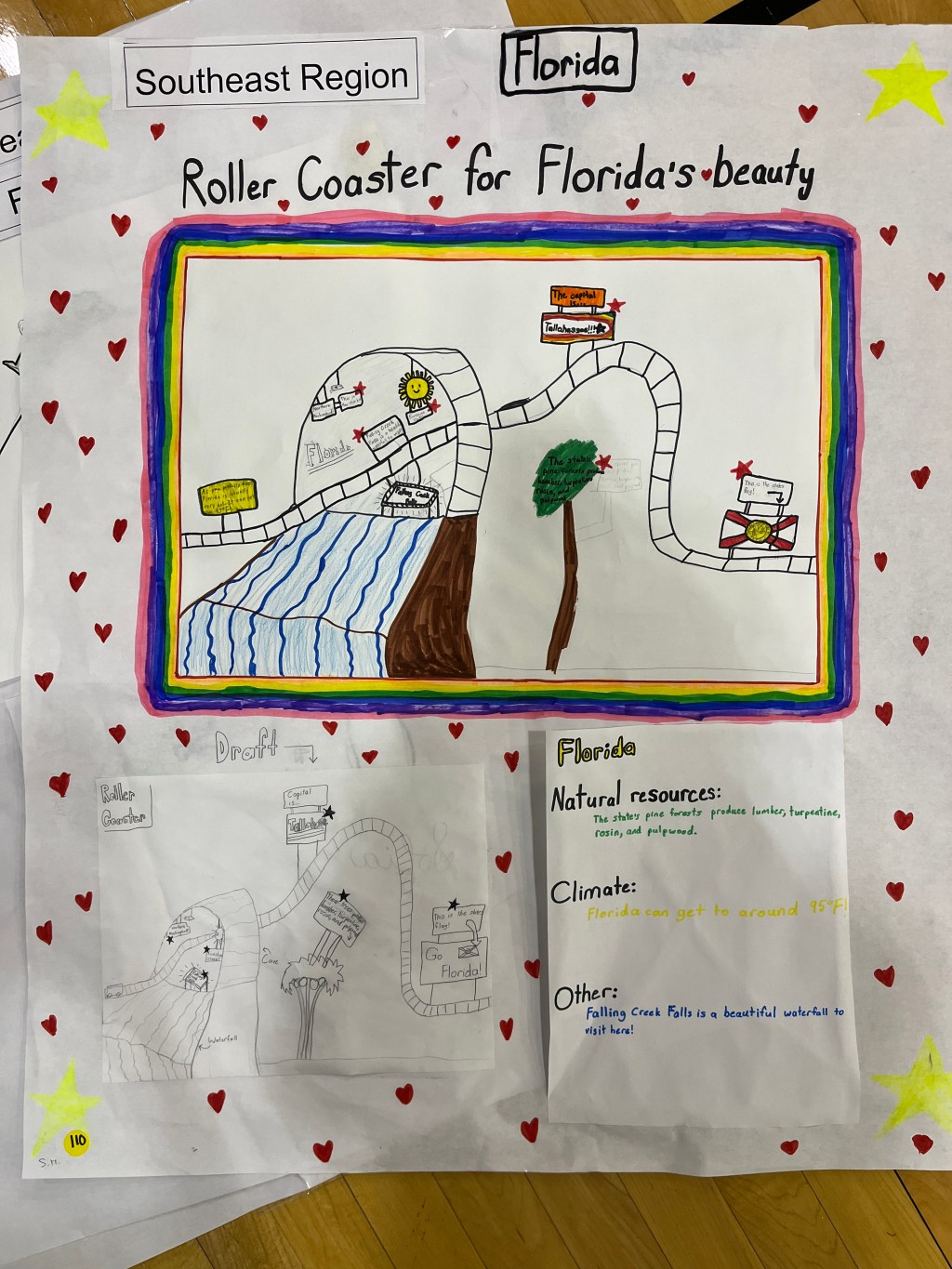
After completing a project based learning (PBL) social studies unit on the regions of the U.S., teachers and students, without exception, spoke highly of the process and the student potential it revealed (Wise, 2023). By providing a scenario whereby students completed a project fueled by their own interests, creativity and research, teachers were able to recognize abilities outside of the traditional scope of the classroom. Because of their own investment in the work, students who previously did little work demonstrated increased motivation, even to the point of asking if they could do extra work on the project at home.
Varied interactive contexts such as the project described above prove effective in uncovering unique abilities that are often obscured in traditional classroom environments. In the June 2023 issue of Gifted Education International, Maker et al. (2023) define nine areas of gifted characteristics, three of which align closely with this project: creative/expressive, relational/integrative, and, in some cases, mechanical/technical. Through designing a regional theme park attraction, students had the opportunity to consider how to represent regional facts in a snack bar, how to present information in an attractive yet effective way, and how to create a design that could, ostensibly, be built in the real world. If they were to write an essay on a region or take a multiple-choice quiz, students could not demonstrate the same variety of gifts as in an interactive, project based unit such as the theme park showcase.
Varied interactive contexts such as the project described above prove effective in uncovering unique abilities that are often obscured in traditional classroom environments.
When PBL is not offered at the general education level, those who excel outside of math or language arts (e.g. a child with profound dyslexia and high engineering ability) have limited contexts in which to demonstrate their gifts. These missed opportunities to recognize and encourage student ability can negatively impact students long after their secondary school career (Smedsrud, 2018), particularly those with low-income status who have less access to fee-based enrichment activities (Anderson, 2020; Plucker & Peters, 2018) and more heavily rely on a free and fair education to fully develop their potential.
Providing higher-level thinking opportunities to all students through enrichment and PBL allows a wider variety of student abilities to grow and be recognized as gifts which are important to both their individual and our collective futures.
Anderson, B. N. (2020). “See Me, See Us”: Understanding the intersections and continued marginalization of adolescent gifted Black girls in U.S. classrooms. Gifted Child Today, 43(2), 86–100. https://doi.org/10.1177/1076217519898216
Maker, C. J., Pease, R., & Zimmerman, R. H. (2023). Developing scientific, transformational, eloquent, artistic, mathematical, mechanical, emotional, relational, and social talents through problem solving: A conceptual, practical, evidence-based analysis. Gifted Education International, 39(2), 104–128. https://doi.org/10.1177/02614294231153519
Plucker, J. A., & Peters, S. J. (2018). Closing poverty-based excellence gaps: Conceptual, measurement, and educational issues. Gifted Child Quarterly, 62(1), 56–67. https://doi.org/10.1177/0016986217738566
Smedsrud J. (2018). Mathematically gifted accelerated students participating in an ability group: A qualitative interview study. Frontiers in Psychology, 9, 1359. https://doi.org/10.3389/fpsyg.2018.01359
Wise, L. R. (2023). Genius Move: Recognizing Gifted Potential Through a Project Based Learning Unit of Study. ProQuest Dissertations Publishing. https://www.proquest.com/openview/87269f080d782ead14d2174ee01bcba9/1.pdf
 Gifted Weekly